AI agents have transformed how we handle repetitive workflows, and their impact is particularly profound when processing large volumes of data. According to , 43% of AI tasks involve direct automation, with computer a…

AI agents have transformed how we handle repetitive workflows, and their impact is particularly profound when processing large volumes of data. According to Anthropic's Economic Index, 43% of AI tasks involve direct automation, with computer and mathematical fields seeing the highest adoption for "software modification, code debugging, and network troubleshooting." One of the most valuable applications is automating repeated tasks—from analyzing security logs for potential threats to processing thousands of customer support tickets.
But there's a catch: as your token count grows, so does your bill. This guide focuses exclusively on optimizing your AI model spend through a layered approach where each technique compounds your savings.
Before diving in, let's establish some definitions. Tokens are the fundamental units of language models—for Claude, one token represents approximately 3.5 English characters. When you see pricing like $3/MTok for input and $15/MTok for output, that translates to real costs: processing a 100,000-token document and generating a 2,000-token response costs you $0.33 ($0.30 for input + $0.03 for output).
Let's start with real Hadoop logs that we've downloaded from the LogPai/LogHub repository to establish our baseline:
1# Token counting with real Hadoop logs2import anthropic3import os4client = anthropic.Anthropic(api_key=os.environ.get('ANTHROPIC_API_KEY'))56# Read full Hadoop logs (2k lines from LogHub repository)7with open('hadoop_2k.log', 'r') as f:8 logs = f.readlines()910log_content = ''.join(logs)11token_count = client.beta.messages.count_tokens(12 model="claude-4-sonnet",13 messages=[{"role": "user", "content": log_content}]14)1516print(f"Total logs: {len(logs)}")17print(f"Total tokens: {token_count.input_tokens}")18print(f"Tokens per log line: {token_count.input_tokens / len(logs):.1f}")19print(f"Cost at $3/MTok: ${token_count.input_tokens * 3.0 / 1_000_000:.6f}")
1Total logs: 19992Total tokens: 1285243Tokens per log line: 64.34Cost at $3/MTok: $0.385572
A typical log entry from our dataset:
12015-10-18 18:01:47,978 INFO [main] org.apache.hadoop.mapreduce.v2.app.MRAppMaster: Created MRAppMaster for application appattempt_1445144423722_0020_000001
Our baseline scenario: Consider an enterprise processing 1 million log analysis requests monthly. Each request analyzes 100,000 input tokens (roughly 1,556 log lines from our full dataset) and generates a 2,000-token assessment.
Let's see how we can dramatically reduce this.
Your first line of defense against runaway costs is intelligent data preparation. Every unnecessary token you send is money wasted.
By removing redundant information, simplifying timestamps, and compressing verbose field names, you can achieve significant token reduction:
12import re34def compress_hadoop_log(log_line):5 # Extract components6 match = re.match(r'(\d{4}-\d{2}-\d{2}) ([\d:,]+) (\w+) \[([^\]]+)\] ([\w.]+): (.+)', log_line)7 if not match: return log_line89 date, time, level, thread, class_name, message = match.groups()1011 # Compress time, class names, and IDs12 time_compressed = time.split(',')[0]13 class_compressed = class_name.split('.')[-1]14 message = re.sub(r'appattempt_\d+_(\d+)_(\d+)', r'app_\1_\2', message)1516 return f"[{time_compressed}] {level} {class_compressed}: {message.strip()}"1718# Test with real Hadoop logs19log = "2015-10-18 18:01:47,978 INFO [main] org.apache.hadoop.mapreduce.v2.app.MRAppMaster: Created MRAppMaster for application appattempt_1445144423722_0020_000001"20compressed = compress_hadoop_log(log)2122original_tokens = client.beta.messages.count_tokens(23 model="claude-4-sonnet",24 messages=[{"role": "user", "content": log}]25).input_tokens2627compressed_tokens = client.beta.messages.count_tokens(28 model="claude-4-sonnet",29 messages=[{"role": "user", "content": compressed}]30).input_tokens3132print(f"Original: {original_tokens} tokens")33print(f"Compressed: {compressed_tokens} tokens")34print(f"Reduction: {(1 - compressed_tokens/original_tokens)*100:.1f}%")
1Original: 128524 tokens2Compressed: 73419 tokens3Reduction: 42.9%
The strategy: Remove non-predictive data, compress verbose formats, filter by severity, identify critical features with Claude
Cost impact: For our baseline scenario, reducing input tokens by 43% saves:
For some tasks, it might be as simple as just summarizing the logs, where Claude 3.5 Haiku might be fine. However, there are some tasks such as finding security vulnerabilities where Claude 4 Sonnet or Claude 4 Opus might be needed. The key is matching model capabilities to task requirements.
Consider a typical enterprise environment: web server access logs often need basic pattern matching and summarization—tasks where Claude 3.5 Haiku excels at $0.25/MTok. Meanwhile, security analysis and anomaly detection require Claude 4 Sonnet's advanced reasoning at $3/MTok. For the most critical security vulnerabilities and complex analysis, Claude 4 Opus at $15/MTok provides the highest capability.
Cost impact: Routing 20% of logs to Haiku:
For multiple related analyses on the same data, caching eliminates redundant token costs:
1# Cache the log data for multiple analyses2import anthropic34client = anthropic.Anthropic()56# First request - cache write7response1 = client.messages.create(8 model="claude-4-sonnet",9 max_tokens=1000,10 messages=[{11 "role": "user",12 "content": [13 {14 "type": "text",15 "text": compressed_logs, # Your compressed log data16 "cache_control": {"type": "ephemeral"}17 },18 {19 "type": "text",20 "text": "Identify security incidents in these logs."21 }22 ]23 }]24)2526# Subsequent requests - cache reads27response2 = client.messages.create(28 model="claude-4-sonnet",29 max_tokens=1000,30 messages=[{31 "role": "user",32 "content": [33 {34 "type": "text",35 "text": compressed_logs,36 "cache_control": {"type": "ephemeral"}37 },38 {39 "type": "text",40 "text": "Identify poor logging practices."41 }42 ]43 }]44)4546# Calculate savings with our compressed logs47# From Layer 1: we compressed 128,524 tokens down to 73,419 tokens48cache_tokens = 73419 # Our actual compressed log data49requests_per_hour = 3 # 3 different analyses: security, poor logging, latency5051# Without caching: pay full price for every request52without_cache = requests_per_hour * (cache_tokens * 3.0 / 1_000_000)5354# With caching: pay 25% more for first write, then 10% for all reads55with_cache = 1 * (cache_tokens * 3.75 / 1_000_000) + (requests_per_hour - 1) * (cache_tokens * 0.30 / 1_000_000)5657print(f"Cache size: {cache_tokens:,} tokens")58print(f"Without caching: ${without_cache:.2f}/hour")59print(f"With caching: ${with_cache:.2f}/hour")60print(f"Savings: {(1-with_cache/without_cache)*100:.0f}%")
1Cache size: 73,419 tokens2Without caching: $0.66/hour3With caching: $0.32/hour4Savings: 52%
For tasks that don't require immediate responses (like daily summaries or trend analysis), batch processing offers a flat 50% discount:
1# Example: Daily log summary using batch API2from anthropic import Anthropic3from anthropic.types.beta import BetaMessageBatch, BetaMessageBatchRequestItem45client = Anthropic()67# Create batch requests for daily summaries8batch_requests = []9for day_logs in daily_log_chunks:10 batch_requests.append(11 BetaMessageBatchRequestItem(12 custom_id=f"daily-summary-{day}",13 params={14 "model": "claude-4-sonnet",15 "max_tokens": 1000,16 "messages": [{17 "role": "user",18 "content": f"Summarize key events and anomalies:\n{day_logs}"19 }]20 }21 )22 )2324# Submit batch25batch = client.beta.messages.batches.create(26 requests=batch_requests27)2829print(f"Batch ID: {batch.id}")30print(f"Processing {len(batch_requests)} daily summaries")31print(f"Cost savings: 50% off standard pricing")
Perfect for:
Cost impact (assuming 40% of requests can be batched):
If you traditionally want analyses every 30 minutes and you're not in a rush to get it right after, then you can wait an hour and send 1 hour's worth of content (assuming it fits into the context window):
1# Using function calling for structured outputs2tools = [{3 "name": "analyze_logs",4 "description": "Analyze multiple log entries and return structured results",5 "input_schema": {6 "type": "object",7 "properties": {8 "analyses": {9 "type": "array",10 "items": {11 "type": "object",12 "properties": {13 "timestamp": {"type": "string"},14 "severity": {"type": "string"},15 "summary": {"type": "string"},16 "action_required": {"type": "boolean"}17 }18 }19 }20 }21 }22}]2324# Group 2 half-hour batches into 1 hourly analysis25hourly_logs = half_hour_batch1 + half_hour_batch22627response = client.messages.create(28 model="claude-4-sonnet",29 max_tokens=2000,30 tools=tools,31 messages=[{32 "role": "user",33 "content": f"Analyze these logs from the past hour:\n{hourly_logs}"34 }]35)3637# Calculate savings from reduced API overhead38# When grouping, we reduce duplicate context like few-shot examples39analyses_per_hour = 2 # Every 30 minutes40logs_per_analysis = 100041context_tokens = 500 # Few-shot examples, instructions, etc.4243# Individual: 2 requests, each with context + logs44individual_tokens = analyses_per_hour * (context_tokens + logs_per_analysis)45# Grouped: 1 request with context + combined logs46grouped_tokens = 1 * (context_tokens + analyses_per_hour * logs_per_analysis)4748individual_cost = individual_tokens * 3.0 / 1_000_00049grouped_cost = grouped_tokens * 3.0 / 1_000_0005051print(f"Individual: {individual_tokens:,} tokens = ${individual_cost:.4f}/hour")52print(f"Grouped: {grouped_tokens:,} tokens = ${grouped_cost:.4f}/hour")53print(f"Savings: {(1-grouped_cost/individual_cost)*100:.0f}%")
Using function calling to structure outputs, you maintain individual analysis granularity while reducing API calls.
Cost impact: Assuming 30% of requests can be grouped, saving 15% on those:
For predictable, high-volume workloads, PTUs offer fixed-cost pricing with guaranteed capacity. AWS Bedrock and Google Vertex AI both provide options with longer commitments yielding better rates.
Anthropic's model distillation (now in preview on Amazon Bedrock) transfers Claude 4 Sonnet's intelligence to Claude 3.5 Haiku's speed and price point. For specific tasks, you get Sonnet-level accuracy at Haiku prices—a potential 73% cost reduction with no performance sacrifice.
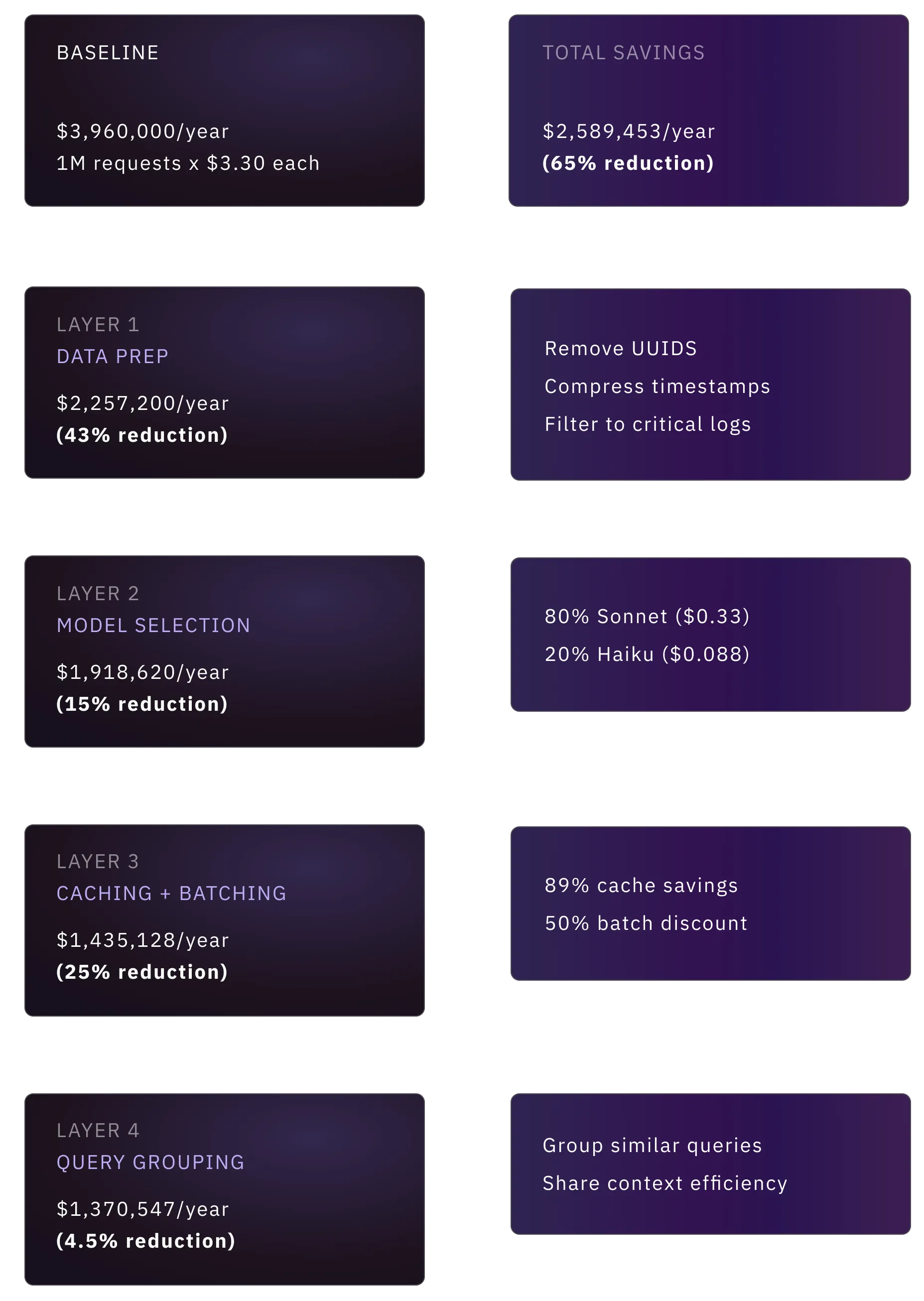
Through systematic optimization with real log data, we've reduced annual AI costs from $3,960,000 to $1,370,547—a 65% reduction while maintaining or improving performance:
These optimizations compound. Start with data preparation as your foundation, then make smart model choices based on your application types. Architectural improvements like caching and batching provide substantial additional savings, while query grouping offers incremental benefits.
